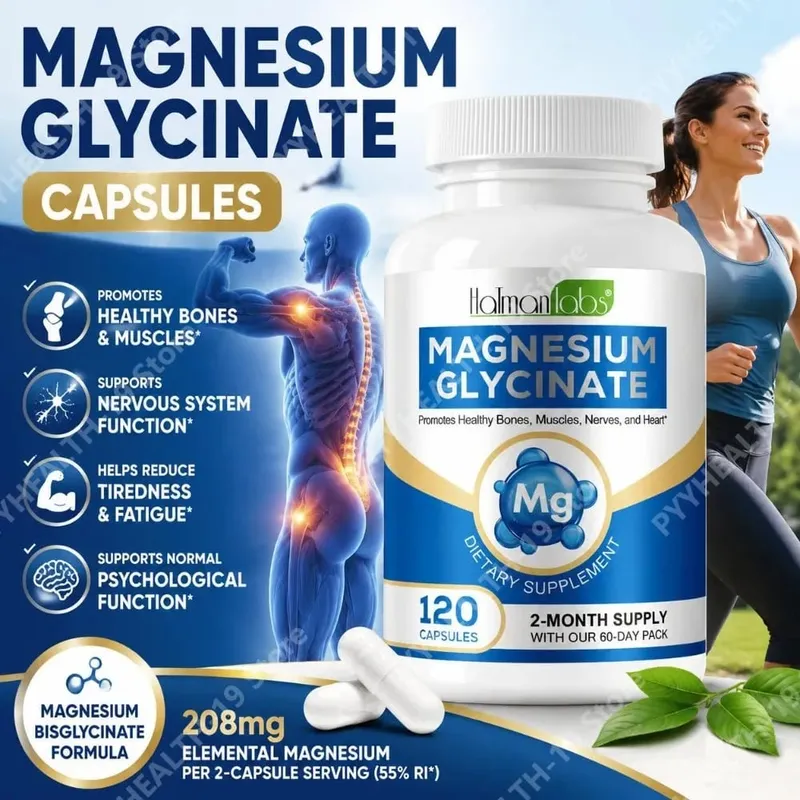
I've been selling supplements long enough to know that most magnesium products on the shelf are basically the same thing in different bottles. Magnesium oxide, magnesium citrate, magnesium carbonate — cheap to produce, easy to source, and they move fast because the price tag looks friendly. But when customers come back and say "it didn't really agree with me," nine times out of ten they were taking one of those forms. So when I got the chance to stock a glycinate product with a real, honest dosage on the label, I took it. That's what this is. One bottle, 120 capsules, 208mg of elemental magnesium per serving from magnesium bisglycinate. No proprietary blends, no flavor dust, no fillers doing the heavy lifting. If you've been burned by magnesium before, this is the version worth trying.
First, what you're actually holding. The capsule shell is standard gelatin — nothing exotic — and the magnesium inside is bound to glycine, which is an amino acid. That bond is the whole point. Magnesium oxide is cheap because the bond is loose and your body can only grab a fraction of it, which is why you end up with the classic stomach cramping. Glycinate is chelated, meaning the mineral is wrapped in that amino acid and carried through your digestive tract more gently. The capsules themselves are firm, uniform, no powder leakage in the bottle, no weird smell when you open the lid. I've handled batches where the caps feel chalky or slightly soft — these don't. Sealed with a freshness liner, tamper band intact. It's a sturdy bottle with a proper wide mouth, which sounds like a small thing until you're shaking capsules out at 7am half asleep.
Specifications, plain and simple. Each bottle contains 120 capsules. Serving size is two capsules, giving you 208mg of elemental magnesium as bisglycinate. That's roughly half of what most adults need daily from all sources, which is a sensible amount — enough to matter, not so much that you're guessing. The bottle is a standard 120-count size, roughly four and a half inches tall, so it fits on a shelf without hogging space next to the multivitamins. There are no color options for the capsules or the bottle beyond the standard amber-white combo you see in the photos — this isn't a product where color variety makes sense, it's a supplement, not a water bottle. The SKU for our listing is P3256812931250177 if you need to match it against a previous order or check stock with us directly.
As for what it's used for day to day, let me give you the real picture. One customer takes it about an hour before bed because she found it helped her wind down without the groggy feeling she got from other forms. Another is a guy in his fifties who strength trains three times a week and takes it after dinner — his words, not mine: "my legs don't cramp up on the drive home anymore." Then there's the simplest use case, which is just filling a gap. Most people aren't getting enough magnesium from food, period. Leafy greens, nuts, beans — great, but if you're eating like a normal human being with a job and kids, you're probably short. This is for the person who wants to cover that base without a production around it.
How to take it: two capsules daily, with or without food, though I'd suggest with food if your stomach runs sensitive. Don't overthink it. You don't need to cycle it, you don't need to stack it with anything. Store the bottle somewhere cool and dry — not the bathroom shelf above the shower, please, that's where supplements go to die from humidity. Keep the cap on tight. That's the entire maintenance routine. There is no maintenance routine. It's a bottle of capsules.
Now the honest part, because I don't do fluff. Pros: the dosage is clearly stated as elemental magnesium, which is the number that actually matters — a lot of brands list the compound weight and let you do the math, which is borderline dishonest. The glycinate form is gentle on the gut for the vast majority of people. 120 capsules means a two-month supply at the stated serving, which makes the price reasonable spread out. Cons: it's not the cheapest magnesium on the shelf, and if you're used to buying oxide because it's five dollars, this will feel like a jump. Two capsules a day also means if you're someone who hates swallowing pills, this isn't the format for you — there's no powder or gummy version here. And glycinate isn't a laxative the way citrate is, so if you were taking magnesium specifically to keep things moving, this is the wrong tool.
Here's the design logic, from someone who's read too many spec sheets. Magnesium competes with other minerals for absorption in the gut, and it's also irritating to the intestinal lining in its raw ionic form. Binding it to glycine solves both problems — glycine is small, it's well absorbed, and it doesn't fight for the same transport pathways calcium and zinc use. That's why bisglycinate has become the form people recommend when someone says "magnesium upsets my stomach." It suits adults who want steady daily support for bone density, muscle recovery, and normal nerve function — which, to be clear, is the standard language for what magnesium does, not some magic claim. If you're an adult, if you're active or just getting older, if you've tried magnesium before and it didn't sit right, this is built for you. If you need a fast-acting laxative effect, look elsewhere.
Price is 28.81, which works out to under fifty cents a day at the two-capsule serving. I've priced worse products higher. Stop by the shop if you want to see the label in person before committing, or grab it online and message me if anything's unclear. Either way, read the elemental magnesium number before you buy anything else — that's the one that counts.