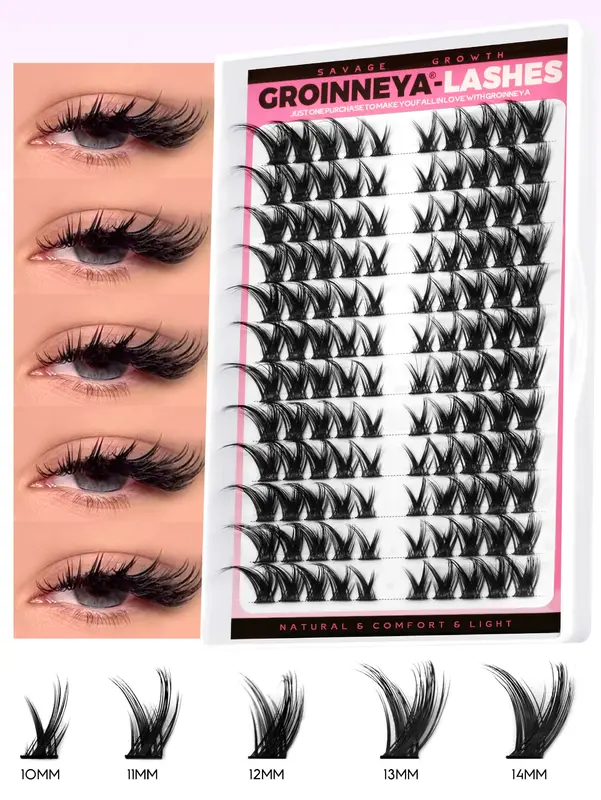
I've sold a lot of lashes over the years. Walk into any beauty supply shop and you'll see walls of them — strip lashes, individuals, clusters, the whole circus. Most of it is fine. Some of it is junk. Every once in a while a tray comes along that I keep restocking because customers actually come back for it, and this cat eye cluster tray is one of those. Let me tell you what you're actually getting before you spend your twelve bucks.
The clusters are made from a soft synthetic fiber — PBT, the same family of material used in most mid-range lash extensions, which means they hold a curl without feeling like fishing line against your eyelid. The band at the base is thin and flexible, not the stiff plastic strip you get with cheap drugstore lashes. When I press one between my fingers, it bends instead of snapping, and that matters more than people realize, because a rigid base is what makes clusters pop off halfway through your day. The fibers taper toward the tips so they look like real hair rather than blunt-cut plastic. Build quality on this tray is genuinely solid for the price point. I've opened trays where half the clusters shed off the band before you even touch them. Not this one.
Now the specifications, because I know some of you want exact numbers. This is a mixed tray, which means you get a range of lengths in one box instead of buying five separate packs. Standard sizes run in the usual range for DIY cluster work, with the shorter lengths sitting around 8 to 10 millimeters and the longer ones reaching roughly 14 to 16 millimeters, depending on which section of the tray you pull from. The curl is a C to D range, which gives you that lifted, open-eye effect the cat eye style is known for. Each cluster holds somewhere between 20 and 40 individual fibers, which is what separates a "volume" cluster from a wispy one. The tray itself holds multiple rows, and this particular SKU — P3256807010925539 — is the mixed configuration rather than a single-length pack. Colors available are the natural black shades you'd expect, so nothing neon or experimental here.
So what do you actually do with these? Three real scenarios. First, the everyday office look: you apply a few short clusters along the outer third of your lash line, and suddenly you look awake in a way that mascara alone never quite manages. Second, the wedding-or-event scenario, where you build a full cat eye with longer clusters at the outer corners and shorter ones tapering inward, and it photographs beautifully because the graduation is smooth rather than a hard jump in length. Third, the lazy Sunday scenario, which is honestly my favorite — you pop three or four clusters on, skip mascara entirely, and you're out the door in four minutes looking like you tried. That's the real selling point of cluster lashes. They compress your routine.
Using them is straightforward if you're patient the first time. Curl your natural lashes, give them a quick wipe to remove any oil, then apply a thin line of cluster lash glue along the base of the cluster and wait about thirty seconds until it goes tacky. Place the cluster as close to your natural lash line as you can without touching skin, press gently, and hold for a few seconds. Work from the outer corner inward if you're doing a cat eye. For maintenance, avoid oil-based makeup removers near the lash line, because oil dissolves the bond faster than anything else. Don't sleep face-down if you can help it. With reasonable care you'll get several days out of a set, sometimes a full week, and the tray itself will last you through many applications because you're only using a fraction of it each time. Store the leftover clusters in the tray with the lid closed so dust doesn't settle on the fibers.
The pros, honestly: the mixed lengths give you flexibility without buying multiple products, the curl holds through humidity, and the price at just over twelve dollars is hard to argue with for the amount of wear you get. The cons, just as honestly: if you've never applied clusters before, your first attempt will probably look slightly uneven, and that's normal — it's a skill, not a magic trick. The glue is not included, so budget for that separately. And if you have very sparse natural lashes, a full volume set might feel heavy until you get used to it. Start with fewer clusters and add.
Here's the design analysis, because this tray is smarter than it looks. The cat eye shape works because it draws the eye outward and slightly up, which lengthens the appearance of the face — that's why makeup artists have used it for decades. A mixed tray supports that shape because the natural cat eye requires a gradient, not a uniform row. If every cluster were the same length, you'd get a blunt, doll-like effect instead, which suits some faces but not most. This tray suits beginners who want room to experiment, people with round or almond eyes who want a lifted look, and anyone who's tired of paying eighty dollars at a salon every three weeks for something they could handle at home in fifteen minutes. If you have hooded eyes, keep the longest clusters at the outer corner only and go shorter through the middle, and it'll open things up nicely. If you're a total perfectionist who wants salon-grade symmetry every single time, honestly, go to a pro — no tray is going to outdo trained hands.