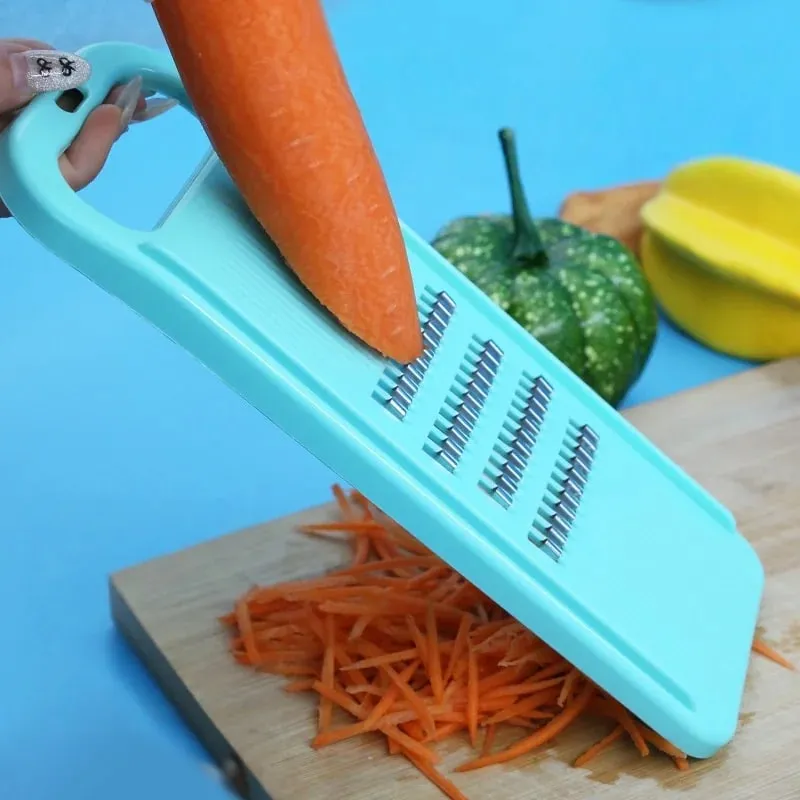
The $10.99 Kitchen Workhorse I Keep Recommending to Friends
I've been selling kitchen tools for a long time, and I'll be honest with you — most gadgets under fifteen bucks are junk. Plastic cracks, blades dull after three carrots, and you're left wishing you'd just bought a decent knife. So when this grater-slicer came through our warehouse and I actually took one home to test, I wasn't expecting much. Two months later, it's still sitting on my counter, and I've bought two more as gifts. That's the short version. Here's the long one.
Let's talk about what it's actually made of, because this is where cheap slicers usually fall apart. The body is food-grade ABS plastic — not the flimsy stuff you can flex with one hand, but a denser, thicker shell that holds its shape when you're pressing down hard on a carrot. The cutting surfaces are stainless steel, and they're stamped rather than laser-cut, which means they're slightly less razor-sharp than a professional mandoline but far more forgiving if your knuckles get close. The blades are set into the frame securely; I tried wiggling one with my thumb and got nothing. No rattle. The non-slip base at the bottom is a silicone ring, and it genuinely grips a wet countertop, which is more than I can say for the last three slicers I tested. Build quality overall? For eleven dollars, it's honestly better than it has any right to be.
Now the specs, because I know some of you want numbers before you commit. The unit measures roughly 28 centimeters long, 11 centimeters wide, and about 6 centimeters tall at the tallest point — it fits in a standard drawer without a fight. The shredding surface is about 9 by 9 centimeters of usable cutting area, which is plenty for home cooking. It comes in standard sizes — one universal frame — and it ships in four colors: green, blue, pink, and white. Nothing oversized, nothing miniature. It's the kind of dimensions that make sense on a real counter in a real kitchen, not a showroom. If you want to find it in our system, the SKU is P3256810229365862, and that's the number to reference if you're comparing it against anything else we stock.
As for what you'd actually use it for — let me give you three real scenarios from my own kitchen. First: taco night. I shred a whole block of cheddar in about forty seconds instead of wrestling with a box grater that skids across the counter. Second: kimchi prep. If you've ever made Korean cabbage at home, you know the salting step needs uniform pieces, and slicing napa cabbage by hand takes forever. This thing handles a whole head in maybe two minutes, and the pieces are consistent enough that the salt penetrates evenly. Third: morning oatmeal. I grate half an apple into my bowl while the kettle boils. It sounds small, but it's the difference between a decent breakfast and cold cereal, and it takes less time than opening a yogurt cup. It also does carrots, zucchini, potatoes, cucumbers, radishes, and cheese of almost any hardness.
Using it is about as simple as it gets. Wash and peel whatever you're working with, hold the slicer at a slight angle over your bowl or board — the silicone base keeps it planted — and push the vegetable down and forward with the included safety holder. Don't use your bare palm on the last inch. I've done it. You'll only do it once. For maintenance, rinse it under warm water immediately after use, before anything dries and sticks to the blade plate. A soft brush handles the crevices. It's technically dishwasher-safe on the top rack, but I hand-wash mine because the heat cycles in a dishwasher will eventually warp even good plastic, and I'd rather it last five years than five months. Dry it upright so water doesn't pool in the frame.
Now the honest part, because I'm not going to pretend this is a professional mandoline. The cons: it's not adjustable — you get one shred size and one slice size, and that's your lot. Hard cheeses like aged parmesan will fight you, and you'll need to press harder than feels comfortable. The capacity is limited to whatever fits between the blade and the frame, so you're working in batches rather than one giant push. And the safety holder, while useful, is a little fiddly to seat properly on round vegetables like potatoes. None of these are dealbreakers at this price. They're just things you should know before you buy, so you're not disappointed when it doesn't julienne a beet into perfect matchsticks.
Here's why this design works, from someone who's watched a lot of these tools fail. Most cheap graters put the blade on a flat plane, which means your knuckles hit the counter before the food does, and you lose control near the end of every piece. This one angles the cutting surface upward, so gravity helps feed the vegetable into the blade and your hand stays above the work. That single design choice is the difference between a tool you use twice and a tool you use weekly. It suits home cooks who prep a lot of vegetables but don't want another bulky appliance, small-apartment dwellers with limited cabinet space, and anyone who's tired of a box grater shredding their knuckles along with the cheese. It's not for someone who needs precision cuts for plating — that's a knife or a real mandoline. But for everyday cooking, it earns its spot.
********